75 Years of FIR – The warning “Never Again Fascism!” is relevant once more today
25. Juni 2026
Message from FIR President Vilmos Hanti
The International Federation of Resistance Fighters (FIR) is celebrating its 75th anniversary. The organization was founded in Vienna in 1951 on the initiative of former partisans, concentration camp survivors, women and men from the anti-fascist resistance fight, and victims of persecution. The goal was clear: to prevent humanity from having to relive the horrors of fascism and world war. For 75 years, the FIR has preserved and championed the legacy of anti-fascist political and armed resistance. Its founding was not merely an organizational act. It was a moral pledge. A pledge that fascism, racism, anti-Semitism, and war must never again plunge humanity into ruin. The historical experience of the founders is clear: fascism does not arise from one moment to the next. It begins with hatred, exclusion, and lies. It continues as people are pitted against one another, social fears are politically exploited, and democratic institutions are gradually eroded.
The existence of the FIR today is not merely a historical memory, but a current political and moral necessity. The motto of the organization’s founding fathers—“Never again fascism! Never again war!” – is once again dramatically relevant today. Far-right movements are gaining strength in Europe and in many countries around the world. In the parliaments of several countries, it is no longer just isolated neo-Nazi groups, but significant political forces that are questioning the foundations of the democratic rule of law and attacking minorities, migrants, trade unions, freedom of the press, and the idea of social solidarity. At the same time, the relativization of history is also on the rise. In several European countries, attempts are being made to equate the anti-fascist struggle for liberation with the crimes of dictatorships, to downplay collaboration with the Nazis, or to portray as heroes those individuals and organizations that were perpetrators of persecution and mass murder. One of the FIR’s most important tasks is therefore to protect the anti-fascist historical memory. It is no coincidence that anti-fascist commemorative events are being attacked in many places, monuments are being damaged, or attempts are being made to push the tradition of resistance out of public life. The debate about history is actually about the present and the future: about what kind of world we want to live in.
The FIR’s task today is also to clearly recognize that modern forms of fascism do not necessarily appear in uniform and with swastikas. They often hide behind slogans such as “restoring order,” “national self-defense,” “security,” or “cultural identity.” Today, hate speech is frequently spread via social media, in political propaganda, or even in the form of conspiracy theories.
The FIR must also respond to the fact that the world has once again entered an era of rearmament. The Russian-Ukrainian war—which is now in its fifth year of unleashing its destructive force in Ukraine—the escalating conflicts in the Middle East, and global military tensions have made the language of militarization the norm once again. Since the end of the Cold War, never before has so much money been spent on military equipment, while the state of social security, healthcare, and education is deteriorating in more and more countries. Drawing on its historical experience, the FIR warns that authoritarian and extremist political forces gain strength more easily in militarized societies. The FIR also sees itself as an actor in peace policy. Its task is to collaborate with peace movements, trade unions, civil society organizations, and all those who reject the politics of hatred and the logic of war.
At the same time, the FIR also faces internal challenges. The generation of participants in the anti-fascist resistance is gradually passing away. One of the most important questions in the coming years will therefore be how today’s generations can be involved in preserving anti-fascist memory and protecting democratic values. The anti-fascism of the future must not be limited to a mere succession of commemorative ceremonies and wreath-laying ceremonies. It must become a vibrant social movement capable of providing answers to the problems of the 21st century: social inequality, racism, war propaganda, the erosion of democratic rights, and attacks on human dignity.
The FIR’s 75th anniversary is therefore not merely a cause for celebration. It is also a reminder. It reminds us that the struggle against fascism is not a closed chapter of history, but one of the most important democratic tasks of the present and the future. Therefore, those who carry on this legacy today bear a particularly great responsibility. Over the course of the FIR’s 75-year history, tens of thousands of people have been active in the organization and its member associations. Former resistance fighters, Holocaust survivors, historians, teachers, workers, students, trade unionists, peace activists, and volunteer citizens have preserved and passed on the idea of anti-fascism. Many of them have carried out this work despite hostility, political pressure, or societal indifference. They deserve our thanks.
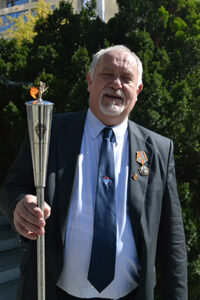
And special thanks go to the “torch-bearers” of today’s generation—those who are taking on this often difficult and unpopular struggle today. Their responsibility is immense. For today, it is no longer enough merely to remember history. We must also understand its lessons and courageously intervene against any development that threatens to drive the world once again toward inhumanity, hatred, and war. The 75th anniversary of the FIR is therefore not only a cause for celebration, but also a warning and a commitment. A commitment to preserve the moral legacy of the anti-fascist resistance for future generations. For the lesson of history remains unchanged even today: Never again fascism! Never again war!